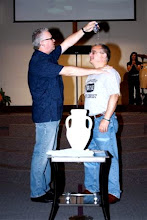
If it were possible, would we like to change anything about our past lives?
Well, while our past can be forgiven, (and that's a good thing) neither God, nor you and I, can change yesterday's regrets, right? While we should "go back" and make restitution with others wherever possible, we cannot go back and relive days gone by.
However, if we would like things in our present and future to be delightfully different than some of the regrets of our past, now's the time to allow God to make the course corrections in our journey.
Will we allow God to change us now and later?
Will we partner with God in total, trust-filled obedience, thereby minimizing future regrets?
Will we allow God to have His way with His clay, today... and tomorrow?
If we say "Yes, to God's will and to His way" right now and continue to say "Yes", I'd forecast for us a very Holy New Year and Beyond, indeed!
So, I offer Hope-filled, Holy Cheers to you my friends! In other words, I'm in for a present and a future focused on minimizing future regrets and maximizing forever rejoicing. How about you?
Let's Live in the Light!
Grateful
Showing posts with label questions. Show all posts
Showing posts with label questions. Show all posts
Thursday, January 1, 2015

Saturday, September 24, 2011
Answers Out Of The Storm
If you are presently in a life-storm, yes if you are barely surviving a confusing season of life where God seems to be silent, maybe even absent, take heart, for while the wind is blowing, the rain is pouring, the lightning is striking, and the thunder is booming, you just might be about to get an answer from the Lord.
Then the LORD answered Job out of the storm.
-- Job 38:1b (NIV)
Note that while God answered Job out of the storm, the confusing season of life he was barely surviving, God also had some questions for Job as well. If you are bold, I invite you to read Job 38 in its entirety.
Holiness Unto The LORD!
Grateful
Saturday, February 26, 2011
Do You "Really" Love Me?
There's an old love song imbeded in my brainwaves (from way back in my teen years). It's an inspiring tune that declares deep devotion with these words: I love you more today than yesterday, but not as much as tomorrow.
Recalling the lyrics of this old love song these days, causes me, as one who claims to be a fully devoted lover of the Lord, to immediately ask a couple of personal and penetrating questions:
(1) Has there been any period of my life when I have loved Jesus more than I love Him presently?
(2) Will I really love my Lord more tomorrow than I do today?
I have had the sacred privilege many times to stand on the banks of the Sea of Galilee in the place that remembers where John 21 actually happened. In John 21:15-23, Jesus challenged the deep devotion of His disciple, Simon Peter. Yes, there where the waves met the shoreline, the seeking Savior asked the floundering fisherman not once, not twice, but three times a personal and penetrating question: Do you love Me? It would not be a stretch to add one word to the question Jesus asked. Do you "really" love Me?
I believe that Jesus still asks those of us who claim to be fully devoted to Him, Do you "really" love Me? Can we answer with these words? I love You more today than yesterday, but not as much as tomorrow? Is our love for the One called Wonderful ever-increasing everyday!
O, how I "really" want to love You, my Jesus...
...more today than yesterday, and even more tomorrow!
Grateful
Thursday, January 7, 2010
Why?
This morning in my quiet time, I sensed the Spirit of the Living God saying to me and now through me:
If your profound questions to God begin with why, the simple answer in each instance is HAVE FAITH IN GOD! Have faith that God knows and that God cares. You may think He has forgot? But the truth to that is... He has not!
Four words from Mark 11:22 provide my strong-faith-footing for today and day-by-day. Yes, especially when many of my profound questions to God begin with why, I have come to know that these four words contain the answers every time: Have faith in God!
IF MY PEOPLE... WILL? I WILL! God's Promise in 2 Chron. 7:14.
Grateful
Sunday, November 15, 2009
Feeling As If God's Forgotten You?
(-: MY LONGEST BLOG POST YET! CONSIDER YOURSELF WARNED! :-)
If you are feeling as if God's forgotten you, can I invite you to read the Old Testament Book of Job, yes the whole book, and read it if you can from the the Message Paraphrase of the Holy Bible. It is powerful, humbling, and helpful, especially if we want to somehow get a view of our human seasons of seemingly undeserved suffering from God's All-knowing perspective.
Here's Eugene Peterson's Introduction to the Book of Job from His Message Paraphrase of the Holy Bible just in case you want to take a few minutes to whet your appetite? It's a little long but a lot enlightening.
Job suffered. His name is synonymous with suffering. He asked, "Why?" He asked, "Why me?" And he put his questions to God. He asked his questions persistently, passionately, and eloquently. He refused to take silence for an answer. He refused to take clichés for an answer. He refused to let God off the hook.
Job did not take his sufferings quietly or piously. He disdained going for a second opinion to outside physicians or philosophers. Job took his stance before God, and there he protested his suffering, protested mightily.
It is not only because Job suffered that he is important to us. It is because he suffered in the same ways that we suffer—in the vital areas of family, personal health, and material things. Job is also important to us because he searchingly questioned and boldly protested his suffering. Indeed, he went "to the top" with his questions.
It is not suffering as such that troubles us. It is undeserved suffering. Almost all of us in our years of growing up have the experience of disobeying our parents and getting punished for it. When that discipline was connected with wrongdoing, it had a certain sense of justice to it: When we do wrong, we get punished.
One of the surprises as we get older, however, is that we come to see that there is no real correlation between the amount of wrong we commit and the amount of pain we experience. An even larger surprise is that very often there is something quite the opposite: We do right and get knocked down. We do the best we are capable of doing, and just as we are reaching out to receive our reward we are hit from the blind side and sent reeling.
This is the suffering that first bewilders and then outrages us. This is the kind of suffering that bewildered and outraged Job, for Job was doing everything right when suddenly everything went wrong. And it is this kind of suffering to which Job gives voice when he protests to God.
Job gives voice to his sufferings so well, so accurately and honestly, that anyone who has ever suffered—which includes every last one of us—can recognize his or her personal pain in the voice of Job. Job says boldly what some of us are too timid to say. He makes poetry out of what in many of us is only a tangle of confused whimpers. He shouts out to God what a lot of us mutter behind our sleeves. He refuses to accept the role of a defeated victim.
It is also important to note what Job does not do, lest we expect something from him that he does not intend. Job does not curse God as his wife suggests he should do, getting rid of the problem by getting rid of God. But neither does Job explain suffering. He does not instruct us in how to live so that we can avoid suffering. Suffering is a mystery, and Job comes to respect the mystery.
In the course of facing, questioning, and respecting suffering, Job finds himself in an even larger mystery—the mystery of God. Perhaps the greatest mystery in suffering is how it can bring a person into the presence of God in a state of worship, full of wonder, love, and praise. Suffering does not inevitably do that, but it does it far more often than we would expect. It certainly did that for Job. Even in his answer to his wife he speaks the language of an uncharted irony, a dark and difficult kind of truth: "We take the good days from God—why not also the bad days?"
But there is more to the book of Job than Job. There are Job’s friends. The moment we find ourselves in trouble of any kind—sick in the hospital, bereaved by a friend’s death, dismissed from a job or relationship, depressed or bewildered—people start showing up telling us exactly what is wrong with us and what we must do to get better. Sufferers attract fixers the way road-kills attract vultures. At first we are impressed that they bother with us and amazed at their facility with answers. They know so much! How did they get to be such experts in living?
More often than not, these people use the Word of God frequently and loosely. They are full of spiritual diagnosis and prescription. It all sounds so hopeful. But then we begin to wonder, "Why is it that for all their apparent compassion we feel worse instead of better after they’ve said their piece?"
The book of Job is not only a witness to the dignity of suffering and God’s presence in our suffering but is also our primary biblical protest against religion that has been reduced to explanations or "answers." Many of the answers that Job’s so-called friends give him are technically true. But it is the "technical" part that ruins them. They are answers without personal relationship, intellect without intimacy. The answers are slapped onto Job’s ravaged life like labels on a specimen bottle. Job rages against this secularized wisdom that has lost touch with the living realities of God.
In every generation there are men and women who pretend to be able to instruct us in a way of life that guarantees that we will be "healthy, wealthy, and wise." According to the propaganda of these people, anyone who lives intelligently and morally is exempt from suffering. From their point of view, it is lucky for us that they are now at hand to provide the intelligent and moral answers we need.
On behalf of all of us who have been misled by the platitudes of the nice people who show up to tell us everything is going to be just all right if we simply think such-and-such and do such-and-such, Job issues an anguished rejoinder. He rejects the kind of advice and teaching that has God all figured out, that provides glib explanations for every circumstance. Job’s honest defiance continues to be the best defense against the clichés of positive thinkers and the prattle of religious small talk.
The honest, innocent Job is placed in a setting of immense suffering and then surrounded by the conventional religious wisdom of the day in the form of speeches by Eliphaz, Bildad, Zophar, and Elihu. The contrast is unforgettable. The counselors methodically and pedantically recite their bookish precepts to Job. At first Job rages in pain and roars out his protests, but then he becomes silent in awestruck faith before God, who speaks from out of a storm—a "whirlwind" of Deity. Real faith cannot be reduced to spiritual bromides and merchandised in success stories. It is refined in the fires and the storms of pain.
The book of Job does not reject answers as such. There is content to biblical religion. It is the secularization of answers that is rejected—answers severed from their Source, the living God, the Word that both batters us and heals us. We cannot have truth about God divorced from the mind and heart of God.
In our compassion, we don’t like to see people suffer. And so our instincts are aimed at preventing and alleviating suffering. No doubt that is a good impulse. But if we really want to reach out to others who are suffering, we should be careful not to be like Job’s friends, not to do our "helping" with the presumption that we can fix things, get rid of them, or make them "better." We may look at our suffering friends and imagine how they could have better marriages, better behaved children, better mental and emotional health. But when we rush in to fix suffering, we need to keep in mind several things.
First, no matter how insightful we may be, we don’t really understand the full nature of our friends’ problems. Second, our friends may not want our advice. Third, the ironic fact of the matter is that more often than not, people do not suffer less when they are committed to following God, but more. When these people go through suffering, their lives are often transformed, deepened, marked with beauty and holiness, in remarkable ways that could never have been anticipated before the suffering.
So, instead of continuing to focus on preventing suffering—which we simply won’t be very successful at anyway—perhaps we should begin entering the suffering, participating insofar as we are able—entering the mystery and looking around for God. In other words, we need to quit feeling sorry for people who suffer and instead look up to them, learn from them, and—if they will let us—join them in protest and prayer. Pity can be nearsighted and condescending; shared suffering can be dignifying and life-changing. As we look at Job’s suffering and praying and worshiping, we see that he has already blazed a trail of courage and integrity for us to follow.
But sometimes it’s hard to know just how to follow Job’s lead when we feel so alone in our suffering, unsure of what God wants us to do. What we must realize during those times of darkness is that the God who appeared to Job in the whirlwind is calling out to all of us. Although God may not appear to us in a vision, he makes himself known to us in all the many ways that he describes to Job—from the macro to the micro, from the wonders of the galaxies to the little things we take for granted. He is the Creator of the unfathomable universe all around us—and he is also the Creator of the universe inside of us. And so we gain hope—not from the darkness of our suffering, not from pat answers in books, but from the God who sees our suffering and shares our pain.
Reading Job prayerfully and meditatively leads us to face the questions that arise when our lives don’t turn out the way we expect them to. First we hear all the stock answers. Then we ask the questions again, with variations—and hear the answers again, with variations. Over and over and over. Every time we let Job give voice to our own questions, our suffering gains in dignity and we are brought a step closer to the threshold of the voice and mystery of God. Every time we persist with Job in rejecting the quick-fix counsel of people who see us and hear us but do not understand us, we deepen our availability and openness to the revelation that comes only out of the tempest. The mystery of God eclipses the darkness and the struggle. We realize that suffering calls our lives into question, not God’s. The tables are turned: God-Alive is present to us. God is speaking to us. And so Job’s experience is confirmed and repeated once again in our suffering and our vulnerable humanity.
ALL JOY!
Grateful
Wednesday, September 16, 2009
Is Jesus Really Lord of My Life?
Hear these straight forward words from Jesus in Luke 6:46 (NIV):
Why do you call me, ‘Lord, Lord,’ and do not do what I say?
One of my life mentors, James, reminded me that the Greek definition of the title, Lord, is The Supreme Controller.
So might Jesus actually be asking more plain questions like this in Luke 4:46? Why do you refer to me as the The Supreme Controller of your life, yet refuse to let go of the controls? Why do you call me your King, yet keep yourself on the throne of your life?
Jesus knows the answers to the questions He's asking about who is really Lord in our lives? He doesn't ask us Lordship questions because He doesn't know the answers. He asks us Lordship questions because He's interested in hearing our responses and is lovingly inviting us to really crown Him as Lord, The Supreme Controller, of our lives.
Let's call Him Lord, Lord, because that's Who He really is to us -- The Supreme One in total control of our lives because we have willingly surrendered our all to His Majesty.
ALL JOY!
Grateful
Monday, August 24, 2009
A Question from Jesus, the Son of Man
In Luke 18:8, we read a question from Jesus, the Son of Man:
"...when the Son of Man comes, will He find faith on the earth?"
Lord, I want You to find faith on the earth, especially in me.
And I pray three words from Revelation 22:20 -- Come, Lord Jesus. Amen.
ALL JOY!
Grateful
"...when the Son of Man comes, will He find faith on the earth?"
Lord, I want You to find faith on the earth, especially in me.
And I pray three words from Revelation 22:20 -- Come, Lord Jesus. Amen.
ALL JOY!
Grateful
Saturday, August 1, 2009
Ownership? Are You His?
I often ask myself these questions:
Who do you belong to? Whose are you?
1. Are you yours? ...or... 2. Are you His?
Then I refer to God's Word for the right answers. One right answer is found in 1 Corinthians 6:19b-20a (NLT): You do not belong to yourself, for God bought you with a high price.
And Isaiah 45:9 (NIV) asks a real ownership question: "Does the clay say to the potter, 'What are you making?'" To which I pray from my surrendered heart: Lord, have Your way with Your clay... forever and a day... and today. Amen.
My Desire: Lord, I long to be exclusively YOURS!
ALL JOY!
Grateful
Subscribe to:
Posts (Atom)